

🌸間柄の哲学・和辻哲郎Watsuji Tetsuro’s Philosophy of Aidagara🌸
Common Ground Between Tetsuro Watsuji’s “Philosophy of Aida” and Braille Digital Art

Tetsuro Watsuji
Tetsuro Watsuji was a Japanese philosopher. He proposed the “Philosophy of Aida”, which argues that human beings exist not as isolated individuals but for the first time in their relationships (aida) with other people.
This philosophy distinguishes itself from Western individualism and provides a crucial perspective for deeply considering Japanese culture and ethics.
His major works include Fudo, which discusses the relationship between Japanese climate and human existence, and Rinrigaku (Ethics), which explores the history of Japanese ethical thought.
Watsuji’s philosophy aims to reconcile respect for the individual with social harmony, addressing universal themes relevant to modern theories of community and environmental issues.
Tetsuro Watsuji’s “Philosophy of Aida” is a uniquely Japanese philosophy that re-examines human existence and ethics from a perspective different from Western individualism. Its greatest feature is the way it understands human beings not as single, isolated individuals, but as existing in the “aida” that is created between people.
「What is the core of the “Philosophy of Aida”?
Watsuji focused on the Japanese word for “human being,” ningen (人間), which literally means “between people.” He argued that while the Western concept of “human being” refers to an independent individual, the Japanese word ningen originally includes the nuance of a being that lives within relationships with others, like in “society” or “the world.”
Based on this idea, humans are said to have two aspects:
- The individual aspect: The independent “I”
- The social aspect: The “we” that lives within relationships (aida) with others
These two aspects cannot exist without each other. For example, when we exist as a “husband” or “wife,” or a “teacher” or “student,” that existence only has meaning within the context of our relationship with another person. An individual’s actions and emotions always carry some kind of aida.
Here is the translation:
The idea of “aida” is in stark contrast to Western ethics.
- In Western ethics, the starting point is the independence of the “individual,” and ethics are derived from an individual’s inner conscience or integrity. For example, the norm of “not lying” is viewed as an individual virtue.
- In contrast, Watsuji’s ethics begins with “aida” (interrelation), seeking the origin of ethics within the relationships between people. For example, he would argue that “not lying” is an issue because it breaks the relationship of trust between people. Ethics are seen not only as something internal to the individual, but also as a means to maintain and improve relationships.
「The Relationship between “Aida” and the “Whole”
Watsuji drew a clear line between his philosophy and totalitarianism. He believed that the individual who forms the “aida” (interrelation) and the whole (society or community) that is established through that interrelation cannot exist independently of each other; they are mutually connected.
- An individual cannot exist in isolation from the whole.
- The whole also cannot exist without the connections among independent individuals.
In short, Watsuji’s philosophy seeks to simultaneously pursue respect for the individual and harmony with society, without leaning towards one or the other.
Criticism and Influence
Watsuji’s “Philosophy of Aida” is highly regarded for systematizing a uniquely Japanese view of human beings and ethics. Especially when combined with his work Fudo (Climate and Culture), which examines the relationship between Japan’s climate, culture, and community, his ideas continue to provide an important perspective for cross-cultural dialogue and for thinking about the coexistence of humanity and the environment.
On the other hand, his philosophy has faced criticism. Some see it as a form of “Japan-centric” thought, reinterpreting Western philosophy through a Japanese cultural lens. Others argue that because his philosophy places such a strong emphasis on relationships within a community, it does not adequately address unexpected encounters with “foreigners” or the existence of individuals outside of existing relationships.
Biography of Tetsuro Watsuji
Tetsuro Watsuji was born on March 1, 1889, as the second son of a family of village doctors in Nyono, Hyogo Prefecture (now Himeji City). In the mountainous village, Watsuji’s family, along with the local temple, was considered wealthy. After attending Himeji Middle School, he entered the First Higher School and later the Faculty of Letters at Tokyo Imperial University, majoring in philosophy. The year he graduated, he married Teru Takase.
Initially, he focused on Western philosophy, publishing works like A Study of Nietzsche (1914) and Søren Kierkegaard (1915). However, his interest gradually shifted to Japanese ancient art and culture. His travelogue, Pilgrimage to Ancient Temples (1919), became a popular hit. He continued his research on Japan with collections of essays such as A Study of the History of the Japanese Spirit, published in two parts. In 1925, he was appointed to the ethics course at the Faculty of Letters at Kyoto Imperial University, where he began to study the history of Buddhist ethical thought and Western ethics.
In 1934, he took a position at the Faculty of Letters at Tokyo Imperial University, where he compiled his major academic works, Ethics (three volumes) and A History of Japanese Ethical Thought. As part of his duty to teach “national morality,” he lectured on the Japanese tradition, focusing on reverence for the Emperor. This became a major target of criticism after the war. Even after his retirement, he maintained an interest in politics and contemporary social trends, while also dedicating himself to the study of Buddhist philosophy and cultural history with works such as Katsura Imperial Villa and Kabuki and Joruri Puppet Theater.
He passed away from a myocardial infarction in 1960.
🌸The Philosophy of Aida and Braille Digital Art🌸

There are logical similarities between the philosophy of “aida” and the concept of Braille Digital Art. This is because both share the common idea that meaning and value are created from the relationships between individuals.
1. Understanding the Whole from Individual “Points”
The Philosophy of Aida: Watsuji viewed human beings not as isolated, singular entities (“points” or “individuals”), but as beings who exist within relationships (aida) with others. His philosophy posits that a society and its ethics are formed as a “whole” when these “points” relate to one another.
Braille Digital Art: In this art form, an individual “point” holds no meaning by itself. It’s only when countless points are arranged together that they form a complete image or pattern. The system allows viewers to recognize the whole picture because the individual “points” establish a relationship with each other.
Both concepts share the idea that individual elements (human beings, dots) don’t exist in isolation; instead, they create new meaning and value through their mutual interaction and arrangement.
2The Pursuit of Empathy through Embodiment
The Philosophy of Aida: Watsuji believed that when humans understand the emotions of others, it’s not merely through logic. Instead, we build relationships by empathizing through “bodily gestures”—things like physical movements, facial expressions, and vocal tones. Empathy is a crucial element that makes a relationship possible.
Braille Digital Art: This art form appeals not just to sight but also to touch. By feeling the raised dots of Braille, both the visually impaired and sighted can experience the artwork through the physical act of “touching.” This provides an opportunity for viewers to share sensations with the creator and other viewers, fostering empathy.
Both concepts are similar in that they view sensory experiences through the body as an important medium for creating relationships and empathy with others.
3. Affirming the Existence of Diverse “Individuals”
The Philosophy of Aida: Watsuji’s philosophy aims for people with diverse personalities to acknowledge one another and maintain harmony within their relationships. It rejects isolated individualism and affirms the existence of diverse “individuals” within a relational context.
Braille Digital Art: This art form elevates Braille, a system for the visually impaired, into an art form that can be appreciated by all people, including those who are sighted. By doing so, it contains a message that affirms the existence of “individuals” with diverse senses and perceptions, free from the constraints of a single standard like sight.
I believe that both share a very similar philosophy: they respect individual differences while creating new value within a relationship.
We believe that by pursuing these directions, we can not only use the “Philosophy of Aida” as a concept, but also expand the technical and expressive possibilities of Braille Digital Art, developing it into a more profound artistic movement.
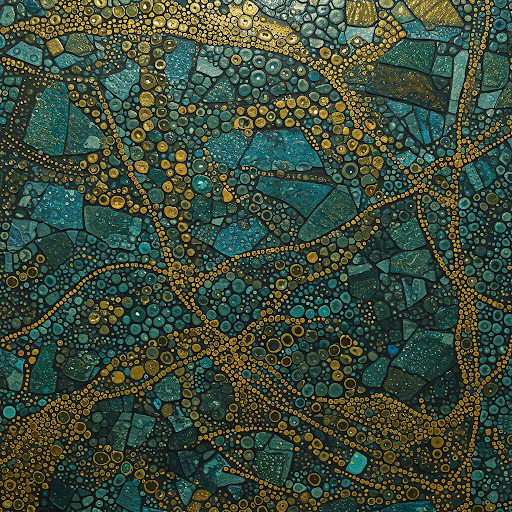
点字デジタルアート